Fort Washington Appliance Repair Co: oven and range repair in Fort Washington, Maryland, booked through the form below and priced from the published band only after the machine has been tested.
Oven and Range Repair in Fort Washington, MD by Fort Washington Appliance Repair Co
Fort Washington Appliance Repair Co sends its own technicians for oven and range repair in Fort Washington, and no repair is priced until the machine itself has shown us what failed.
An oven that will not hold temperature ruins dinner slowly, ten degrees at a time, until somebody notices every roast runs long. We repair ovens and ranges, gas and electric, freestanding and slide in, including the dual fuel models that pair a gas cooktop with an electric oven. The oven does not care that Fort Washington has dinner plans. When it fails, it fails on its own schedule, and the repair has to be built on evidence.
There is a Fort Washington pattern to the work, and it starts with the buildings. Fort Washington's waterfront colonials and established subdivisions along the Potomac, including the Tantallon community, are owner occupied homes with full size kitchens and laundry rooms that see daily family use. Machines installed in the same building wave reach the same wear points in the same seasons, which is why one street can produce five similar calls in a month.
Oven and Range Repair Problems We Diagnose and Repair in Fort Washington
Temperature and baking faults
When one side of the pan browns and the other stays pale, look at the heat source itself: a failing bake element or burner ports blocked unevenly by years of spills. An oven that runs hot or cold by a steady margin usually needs calibration or a new temperature sensor, both small repairs with a big effect on baking. An oven that heats once and then fades during a long bake is often a weak igniter on gas models, drawing too little current to hold the gas valve open. A dead broiler is its own circuit on most ranges; we test the element or burner independently so the quote covers only what failed. Tantallon and the river streets keep machines for decades, and our records are kept to that horizon.
Burners, igniters, and cooktop faults
Electric coil burners that heat on one setting only have usually lost the infinite switch behind the knob, not the element itself. On radiant and induction tops, a dead zone is sorted at the element first and the control second, because the two parts carry very different prices. A gas burner that clicks without lighting may be a fouled spark electrode, a cracked igniter wire, or food debris bridging the burner ports. Repairs are proven under load in Fort Washington before they are called finished.
Doors, controls, and safety
On gas models we leak test connections after any burner or valve work, because a repair that cooks well but seeps gas is not a repair at all. An oven door that will not seal leaks heat and money; hinges bend, springs tire, and gaskets compress flat with age. After a self clean cycle, a door that stays locked is usually a lock assembly or its switch reporting wrong, and it is among the most routine calls we run. Well and septic details on the form change how some visits are planned here, and we ask early.
How We Diagnose Oven and Range Repair in Fort Washington
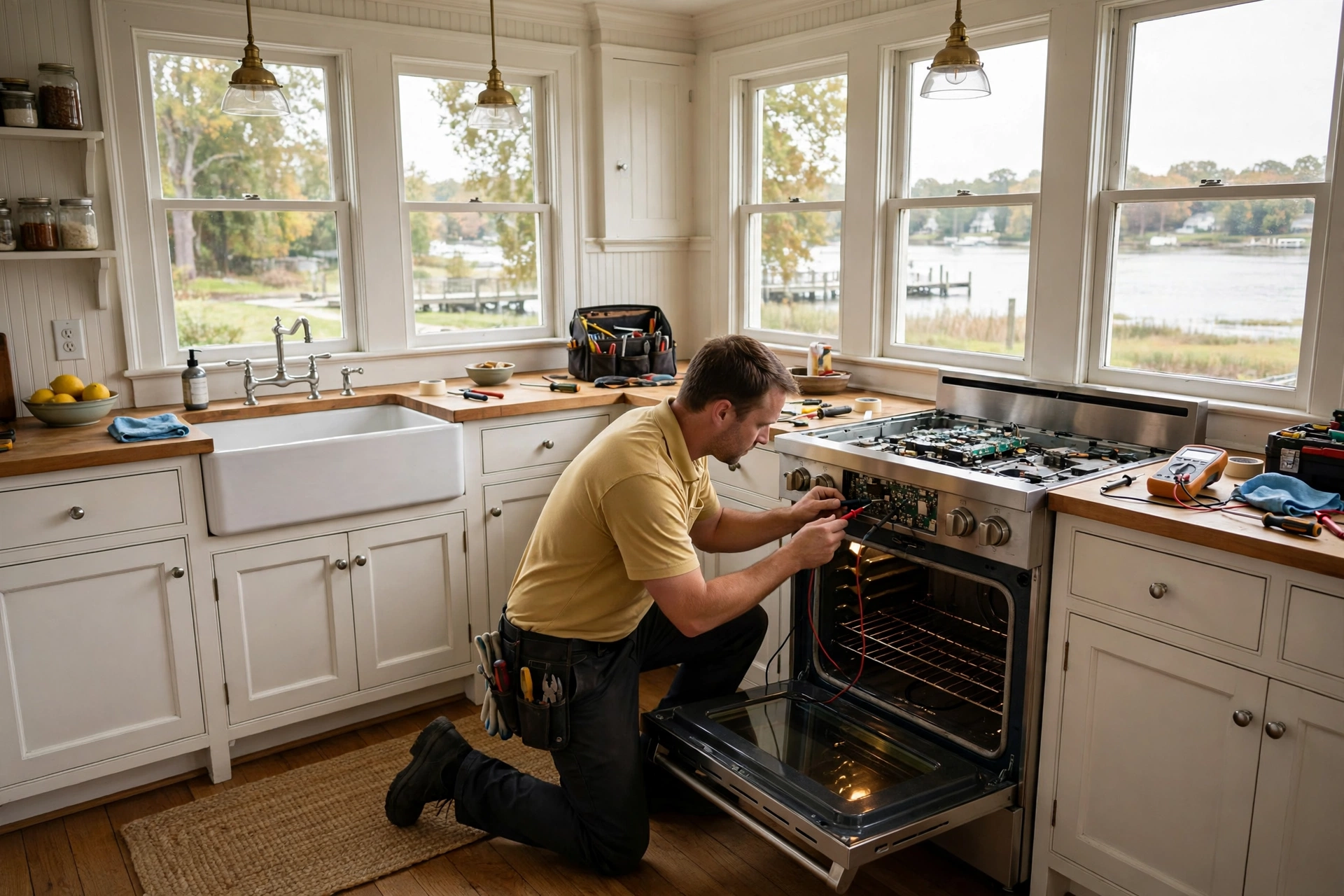
We test temperature the way bakers experience it: a thermometer in the cavity, readings at preheat and across two full cycles, plus element and igniter current draw on the meter. Potomac humidity works on every door seal in Fort Washington all summer long.
Recent Project: Oven and Range Repair in Clinton
BEFOREAFTER
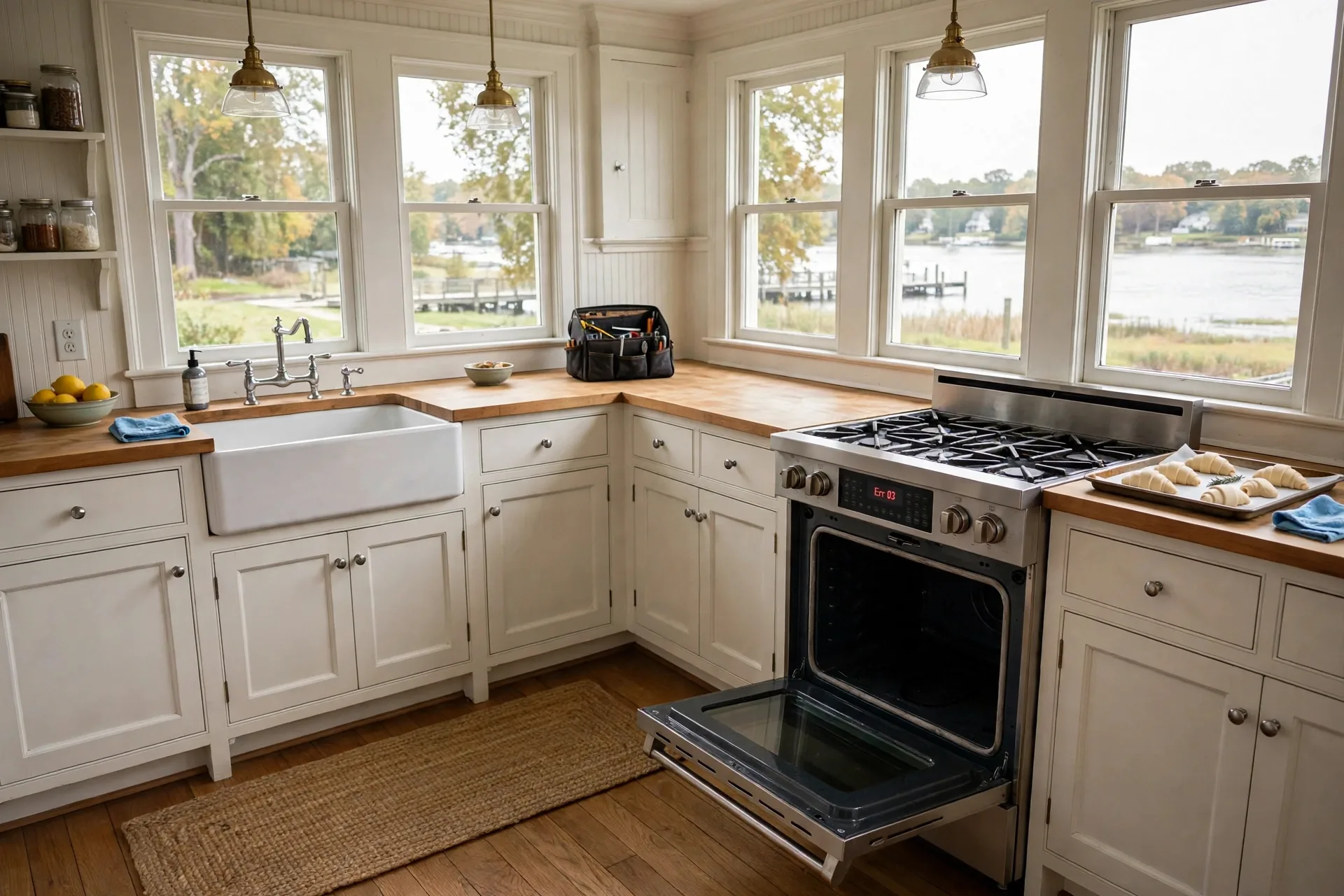
A call from Clinton: Electric oven running forty degrees cold. Testing found the temperature sensor had drifted out of range. We fitted a new sensor, recalibrated the control, and verified three test cycles. Large households here run laundry like a small business, and the diagnosis respects the volume.
Turnaround
Finished in one visit.
Final Price
$235
Oven and Range Repair Cost in Fort Washington, MD
The published guides put cooking repairs around $214 on average. Expect $165 to $380 for the work described here, with igniters, switches, and sensors low in the band and boards at the top. One figure is quoted in writing after diagnosis, and the diagnostic fee folds into the repair when you proceed, which is the arrangement the published guides describe. The visit record, readings and parts noted, stays with the household after we leave.
Why Fort Washington Calls Fort Washington Appliance Repair Co for Oven and Range Repair
Cooking faults hide inside averages: an oven can read 350 on the display and hold 310 in the cavity. We quote from thermometer readings and current draw, so the repair targets the part that is actually lying to you. The details of this oven visit, findings, parts fitted, and readings taken, are written into a visit record you keep. If the machine ever argues with our repair, that record is where the conversation starts. Storm flickers off the river age control boards across neighborhoods in a single evening.
Request an Appliance Repair Quote in Fort Washington, MD
Use the quote form to describe the symptom as you experience it. The plainer the description, the faster the diagnosis starts when we arrive.
Frequently Asked Questions
Why does my oven take so long to preheat?
On gas ranges the weak igniter is the usual story; on electric, a bake element with a dead section. Either way the fix starts with testing, because the same symptom has two different price tags. Garage and lower level units here live harder lives than kitchen machines, and are judged by that standard.
My gas burner clicks but will not light. What is wrong?
Start with the simple causes: debris in the ports and a coated electrode stop more burners than failed parts do. If cleaning does not restore the spark, we test the module and the switch. The visit record, readings and parts noted, stays with the household after we leave.
Is a drifting oven temperature worth repairing?
Yes, in most cases. A sensor or calibration repair is one of the least expensive on this page, and it transforms baking more than any other single fix. We verify the drift with a thermometer first so you know the size of the problem. Repairs are proven under load in Fort Washington before they are called finished.
What does the diagnostic visit cost?
Published guides put a diagnostic visit at $75 to $125, usually credited toward the repair. For cooking appliances it includes temperature verification with a thermometer, so the quote you get is tied to measured performance. Storm flickers off the river age control boards across neighborhoods in a single evening.
Can you repair a oven door that will not close properly?
Yes. Doors are rebuilt with hinges, springs, and gaskets as needed, and the seal is checked with the oven hot. A door that seals restores preheat times and stops the control panel cooking itself. Potomac humidity works on every door seal in Fort Washington all summer long.
Do you repair dual fuel ranges?
Dual fuel is covered on this page: the gas side is tested for ignition and valve function, the electric oven side for element and sensor performance, each with its own measurements. Well and septic details on the form change how some visits are planned here, and we ask early.
Get Your Appliance Repair Quote
Booking starts here. Tell us the appliance, the symptom, and where the machine lives, and the answer you get back carries the published range for the work and a plan for the diagnostic visit that prices it exactly.
Prefer to talk it through first? Send the form and we will call you back at the number you give us.