Fort Washington Appliance Repair Co handles Stacked Laundry Repair in Fort Washington, Maryland. A diagnostic visit confirms what failed, one written figure prices the fix, and work starts on your word.
Stacked Laundry Repair in Fort Washington, MD by Fort Washington Appliance Repair Co
Fort Washington Appliance Repair Co does stacked laundry repair the slow way on purpose: test, document, quote in writing, then repair, so the figure you approve is the figure you pay.
Stacked laundry, both the one piece laundry center and two machines on a stacking kit, packs a full laundry into a closet's footprint and complicates every repair with access. We repair stacked configurations of both kinds and plan the unstacking honestly when a job requires it. Ask around Fort Washington and the stacked laundry unit stories rhyme: the odd noise ignored for a month, the few degrees lost a week at a time, then the call. The diagnosis is what separates the cheap version of that story from the expensive one.
Washer side faults in a stacked body
Washer faults in a laundry center are diagnosed exactly as in a standalone machine; what differs is the route to the part, and we quote that route honestly. Vibration in a stack is amplified by height; suspension wear that a floor machine tolerates will make a closet stack drum against its enclosure. On one piece centers the shared control panel makes fault separation the first job: which half is actually broken is a test, not an assumption. Fort Washington's waterfront colonials and established subdivisions run full size kitchens that owners maintain rather than replace.
Dryer side faults, elevated
Belt and roller work on a stacked dryer may require separating the units, and we say so in the quote rather than discovering it with the machine half apart. The dryer half carries the standard heat circuit, elements or igniters, fuses, thermostats, and its failures are standard; the vent route out of a closet is the stacked specialty. Potomac humidity works on every door seal in Fort Washington all summer long.
How We Diagnose Stacked Laundry Repair in Fort Washington
Stacked diagnosis tests both halves as the machines they are, plus the two stack specific systems: the vent route and the installation itself, level, kit hardware, and clearances. Repairs are proven under load in Fort Washington before they are called finished.
Recent Project: Stacked Laundry Repair in Forest Heights
BEFOREAFTER
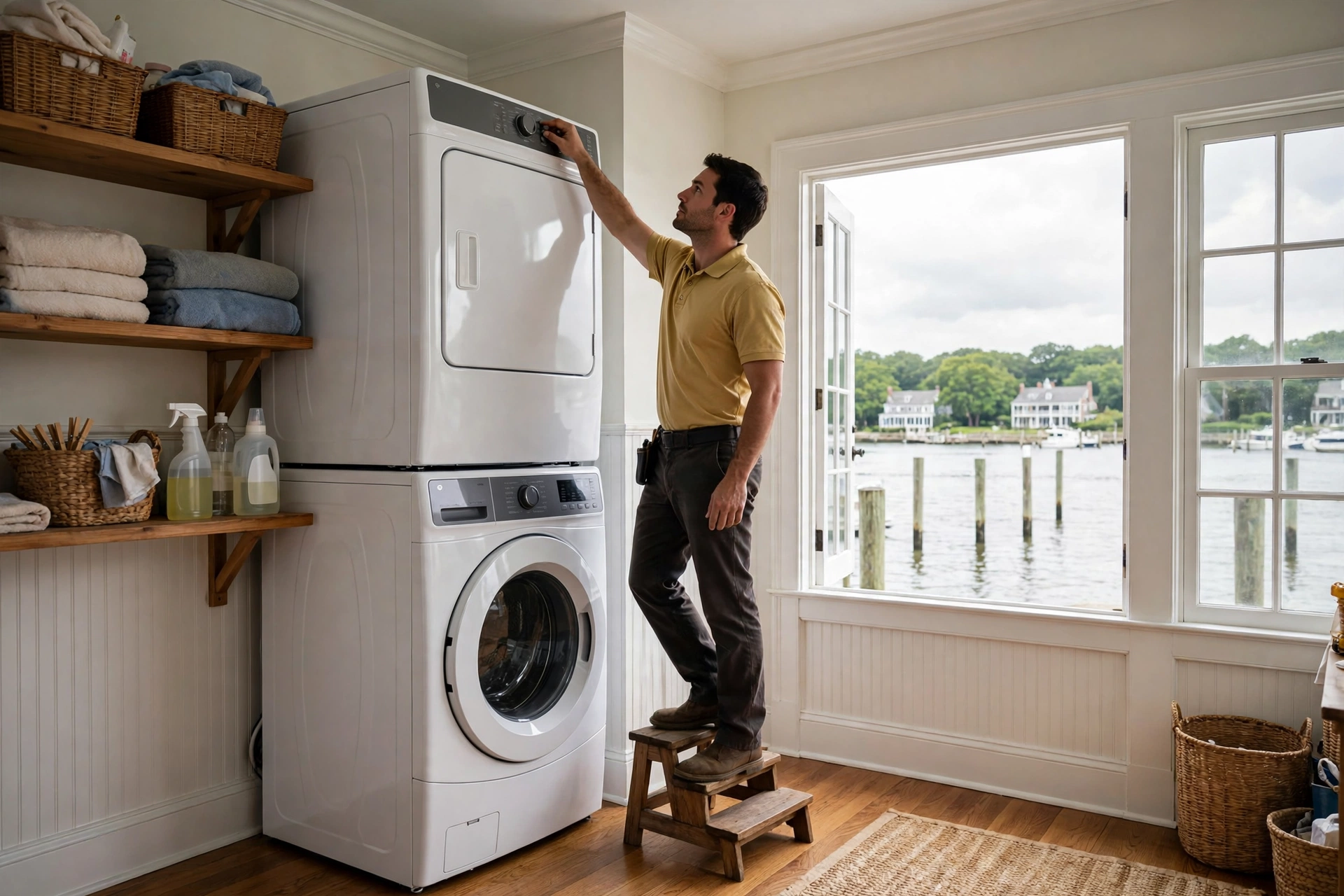
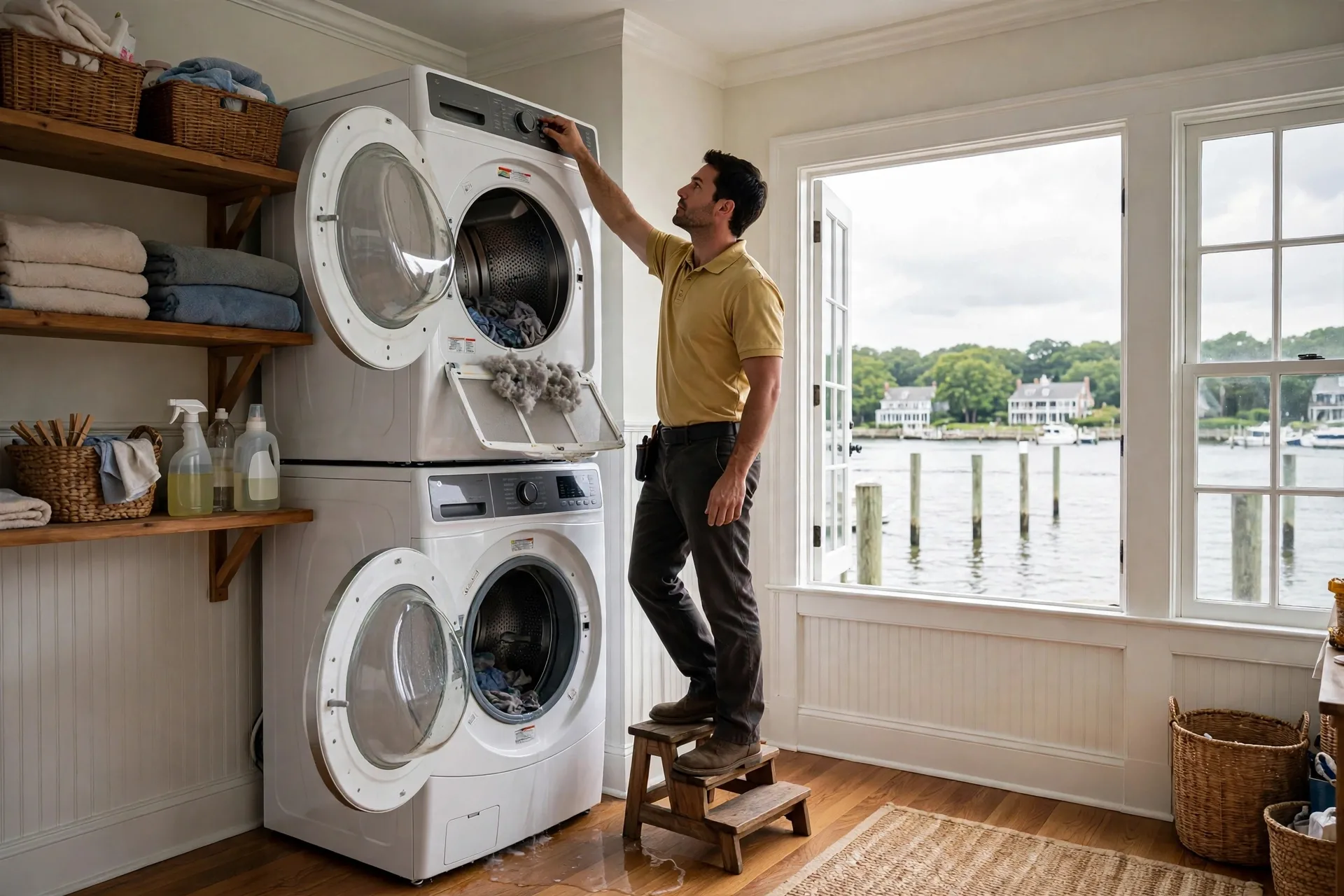
A call from Forest Heights: Stacked pair drumming against its closet walls. Testing found worn washer suspension amplified by a loose stacking kit. We renewed the suspension, refitted the kit hardware, and spin tested a full load quietly. The visit record, readings and parts noted, stays with the household after we leave.
Turnaround
Finished in one visit.
Final Price
$300
Stacked Laundry Repair Cost in Fort Washington, MD
What moves the figure is configuration: a stacking kit pair separates in minutes, while an older unitized center can make a simple part a longer job, and we price the machine you actually own. There are no parts ordered on a hunch: the figure follows the diagnosis, in writing, and it holds for the work described. Well and septic details on the form change how some visits are planned here, and we ask early.
Why Fort Washington Calls Fort Washington Appliance Repair Co for Stacked Laundry Repair
Our rule in closets is transparency about labor: the diagnosis is standard, the access is itemized, and the test at the end is a full load washed and dried in place. Every job on this page ends with the appliance run through its work in front of us. A repair that has not performed is a theory, and we do not leave theories running in your kitchen. Accokeek and Oxon Hill work routes through the same written standard as Fort Washington itself.
Request an Appliance Repair Quote in Fort Washington, MD
Tell us what the stacked laundry unit is doing, or not doing, on the form and we will take it from there: diagnosis first, one written figure, and the repair done properly.
Frequently Asked Questions
Do stacked units have to be separated for every repair?
No. Many washer and dryer faults are reachable in place. When a job does need separation, we tell you before approving the quote, and the labor for it is a line you can see. Storm flickers off the river age control boards across neighborhoods in a single evening.
Why does my stacked dryer take so long to dry?
Closet vent runs are the first suspect: long, bent, and often crushed behind the unit. We measure airflow at the dryer and inspect the route before any dryer part is blamed. Fort Washington's waterfront colonials and established subdivisions run full size kitchens that owners maintain rather than replace.
Can one half of a laundry center be replaced alone?
On unitized centers, no: the halves share a body and controls. On stacked pairs, yes, either machine can be replaced independently, which is a real argument for the kit configuration. Garage and lower level units here live harder lives than kitchen machines, and are judged by that standard.
What does the diagnostic visit cost?
Published guides put a diagnostic visit at $75 to $125, usually credited toward the repair. On a stacked unit it includes both halves tested plus an airflow reading on the vent. Repairs are proven under load in Fort Washington before they are called finished.
Is a stacked washer bearing worth repairing?
It carries the same math as a standalone front loader with access added. We price it fully and compare it against the pair's age and condition in the same conversation. Tantallon and the river streets keep machines for decades, and our records are kept to that horizon.
Do you service laundry centers in condos and apartments?
Yes, including coordination with building access rules and the tight closet dimensions that define this work. Landlords and tenants both book this page regularly. Large households here run laundry like a small business, and the diagnosis respects the volume.
Get Your Appliance Repair Quote
Booking starts here. Tell us the appliance, the symptom, and where the machine lives, and the answer you get back carries the published range for the work and a plan for the diagnostic visit that prices it exactly.
Prefer to talk it through first? Send the form and we will call you back at the number you give us.